
Do Pilots Sleep on Long Flights? Yes, in Hidden Crew Bunks
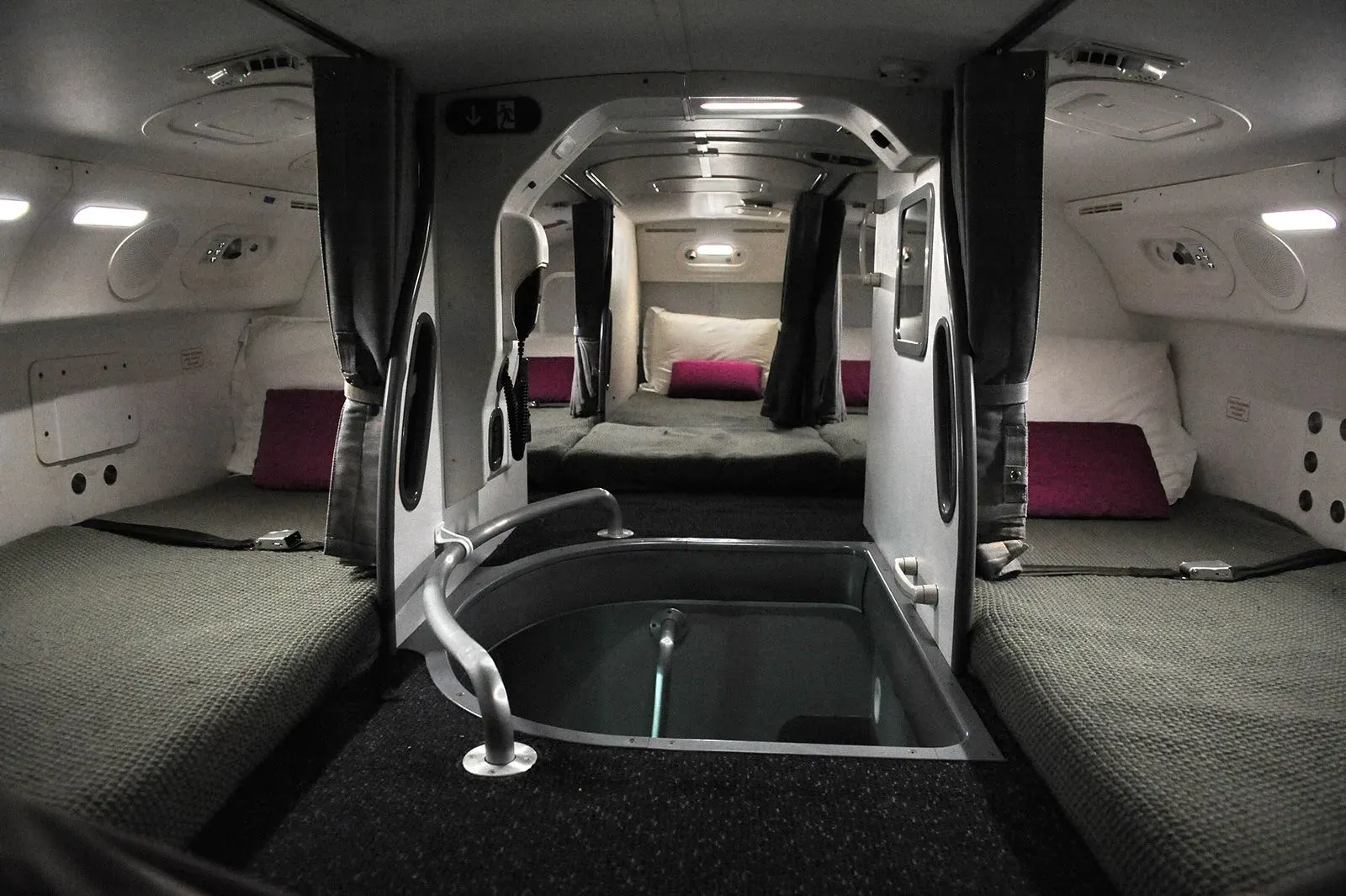
Yes, pilots sleep on long flights, and it is planned before you board. Long-haul flights carry extra pilots who take turns resting in hidden crew bunks, so a fresh pair is always at the controls.
Somewhere over the middle of the Pacific, at three in the morning cabin time, the two pilots flying your plane right now might not be the same two who pushed back from the gate.
Here’s the part that surprises most passengers: some of that sleeping happens in a room you’ve walked right past without knowing it was there. A real bed, behind a door disguised as a galley wall or a ceiling panel, a few feet above your head.
Yes, they rest: the augmented crew
A standard flight has two pilots, a captain and a first officer, and duty-time rules cap how long they can legally stay at the controls without a break. Push past that limit and the flight simply can’t be flown with just the two of them.
So airlines add pilots. Once a route crosses roughly the ten-hour mark, it typically flies with an augmented crew: a third pilot, and on the longest routes, a fourth. That extra headcount buys the flight extra legal hours in the air. A three-pilot crew can push a flight out toward 13 hours, and with a four-pilot crew and the right rest facilities on board, airlines can legally schedule flights up into the high teens. That extra headcount isn’t free: those pilots are paid on the same seniority climb as every other captain and first officer, from a regional first officer’s early years to a senior widebody captain’s six-figure ceiling.
Once airborne, the crew works in shifts. While two pilots fly the plane, the others go off duty and rotate through the crew rest area to sleep, typically in blocks of three to four hours depending on the length of the flight. Nobody flies the entire crossing awake. Everybody flies part of it rested, so the two pilots strapped in for takeoff and landing, the two moments that matter most, are never the two who’ve been up the longest.
Where do pilots sleep on a plane
This is the reveal: on a modern widebody, there’s a hidden bedroom on board, and you’ve almost certainly flown past its door without noticing.
On the Boeing 787 and Airbus A350, the pilot rest compartment usually sits above the main cabin, tucked into the upper fuselage near the front, reached by a narrow stairway behind an unmarked door close to the cockpit. Inside: a couple of real bunks, curtained off, dim lighting, a call button, nothing fancier than a decent sleeper train cabin. The Boeing 777’s layout varies by airline, but the idea’s the same: a separate compartment, off-limits to passengers, built purely for sleep. The Airbus A380 goes further, with crew rest areas holding ten or more bunks stacked capsule-style, because an A380 crew is that much bigger.
Cabin crew get their own separate space, usually further back or below deck, since they work a different shift pattern than the pilots up front. You could fly the same route a hundred times and never know the bunks were seven feet over your head the whole way, which is rather the point: crew rest is designed to be invisible, not shown off.
Controlled rest: keeping it safe, even on shorter flights
None of this is left to instinct. There’s a separate, narrower practice for regular two-pilot flights that don’t carry a third or fourth pilot at all: controlled rest.
Under EASA rules, a genuinely fatigued pilot can take a brief, monitored nap in their seat, roughly 45 minutes including time to settle and recover, while the other pilot stays fully alert and cabin crew are briefed to check in. It’s a safety valve for unplanned fatigue, not a scheduling tool, wrapped in strict handover procedures before and after. Regulators in Canada, Australia, New Zealand, China and elsewhere allow similar procedures. The FAA doesn’t: in the United States, in-seat napping on a standard two-pilot flight isn’t authorized, so rest only happens through an augmented crew with a proper bunk away from the controls.
The science backs the idea up either way. A well-known NASA study on long-haul 747 crews found pilots who took a short planned nap, on average under half an hour, showed a real jump in reaction-time performance and far fewer of the involuntary microsleeps that matter more on a flight deck than a slow blink. The rules vary by regulator, but the logic holds everywhere: a rested pilot is a safer pilot.
The quiet system keeping you safe
Every part of this, the extra pilots, the hidden bunks, the shift rotations, the strict rules around even a 45-minute nap, exists so that whoever is flying the plane at any given second is someone who’s had the chance to rest. It’s unglamorous, invisible from your seat, and drilled to the point of routine. That’s exactly why it works. The next time you’re twelve hours into an overnight crossing and the cabin’s gone quiet, remember there’s a good chance two pilots are asleep a few feet above you, resting for the very shift that’s about to bring you down safely on the other side of the ocean, on one of these ultra-long-haul routes where crew rest stops being optional and becomes the whole design.
The crew lands rested. You, on the other hand, still have the time change to deal with. Our jet lag calculator can build a recovery plan for whichever route you just flew.
FAQ
Do pilots sleep on long flights? Yes. On flights long enough to require an augmented crew, extra pilots rotate through scheduled rest so two alert pilots are always at the controls, especially for takeoff and landing.
Where do pilots sleep on a plane? On widebodies like the 787, A350, 777 and A380, there’s a dedicated crew rest compartment, usually a small bunk area above or near the main cabin, reached through an unmarked door. Cabin crew have a separate rest area of their own.
Is it safe for pilots to sleep during a flight? Yes. It’s a regulated, planned part of the flight, built around duty-time rules and rest facilities the aircraft is certified to carry. The system exists specifically to keep a rested crew at the controls at all times.
Is controlled rest the same as crew rest on an augmented flight? No. Controlled rest is a short, monitored in-seat nap allowed under some regulators, like EASA, for standard two-pilot flights dealing with unexpected fatigue. Full crew rest happens in a proper bunk, only on flights carrying extra pilots. The FAA permits the latter but not the former.
Next time someone asks who’s flying the plane while you sleep through an overnight flight, you’ll actually know. Sign up for the newsletter and we’ll keep sending you the details most passengers never think to ask about.
Read next
Why Is British Airways Called Speedbird? Callsigns Explained
British Airways is called Speedbird after a 1932 Imperial Airways logo. Here's how that bird became BA's radio callsign, and how callsigns work.
How Flying WorksHow High Do Planes Fly? Cruising Altitude, Explained
Most airliners cruise between 31,000 and 42,000 feet, often near 35,000 feet, about 10.7 km up. Here's why that band exists and what caps it.
How Flying WorksWhat Does Mayday Mean? Origin, Pan-Pan and Squawk 7700
Mayday is the radio call for grave and imminent danger, said three times. Where the word comes from, plus what pan-pan, heavy, and squawk really mean.
Liked this?
Get the next one in your inbox. Aviation explained for the people who never lost the wonder. One email, no noise.