
Largest Passenger Plane in the World: The Airbus A380
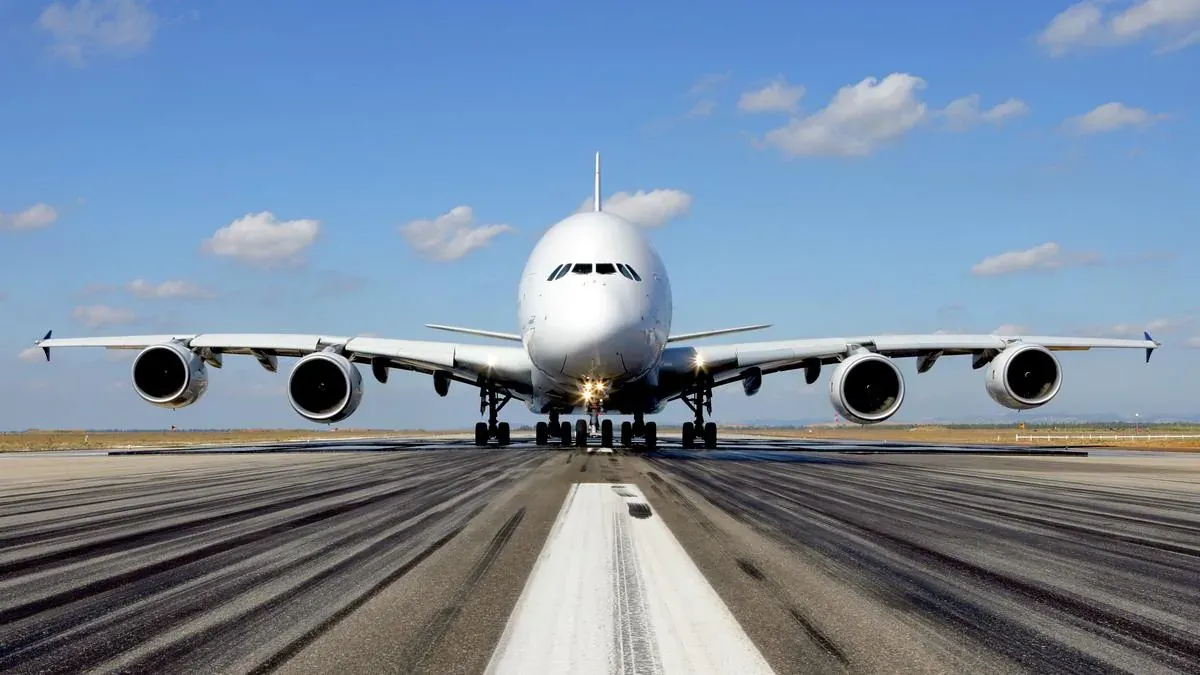
The Airbus A380 is the largest passenger plane in the world. It has two full-length decks, four engines and a wingspan of 79.8 meters (262 feet). Airlines typically seat about 545 people in it, and it is certified to carry up to 853.
Stand under one on the ramp and you won’t need the spec sheet. Two complete decks stacked on top of each other, four engines, wingtips running off toward the horizon in both directions: it looks like a building that decided to fly.
The first time you see one taxi past, your brain quietly refuses the math. Something that size, rolling that slowly on its tires, should not be able to leave the ground. Then it lines up, the four engines spool up into a roar you feel in your ribs, and up to 575 tonnes of airplane lifts off like it weighs nothing. You don’t get used to that. You just get to see it again. Those two full decks also make it one of the easiest planes to pick out from the ground.
Just How Big Is the A380?
Numbers help, but only if you can picture them. The A380’s wingspan is more than twice the distance the Wright brothers covered on their first flight in 1903, which was 120 feet. The cabin runs the full length of the fuselage on both decks, ten seats across in economy on the main deck and eight across upstairs. Add it all up and you get about 550 square meters of cabin, a little more than two tennis courts’ worth of airplane, folded into a tube and sent to cruising altitude.
Airbus quotes a typical four-class layout of 545 seats. In an all-economy layout, the A380 is certified for up to 853 passengers, the maximum Airbus lists for the type. The Boeing 747-8, the plane it was built to beat, seats about 410 in a typical three-class layout.
The Biggest Passenger Planes, Side by Side
| Aircraft | Length | Wingspan | Typical seats |
|---|---|---|---|
| Airbus A380 | 72.7 m (239 ft) | 79.8 m (262 ft) | 545 (four classes) |
| Boeing 747-8 | 76.3 m (250 ft) | 68.4 m (224 ft) | 410 (three classes) |
| Boeing 777-9 | 76.7 m (252 ft) | 71.8 m (235 ft) | 375 to 450 (two classes) |
The A380 wins on seats and wingspan, which is what most people mean by “largest.” Length is where the asterisk comes in. The Boeing 747-8 is about 3.6 meters longer than the A380, and the 777-9 is longer still. At 76.7 meters, it will be the longest airliner ever to enter service.
What Is the Largest Passenger Plane Still in Production?
Airbus delivered its last A380 in December 2021, and Boeing delivered its last 747 in January 2023. That leaves the Boeing 777-9 as the biggest passenger jet still being built. It has two engines instead of four, it seats fewer people than the A380, and it hasn’t carried a paying passenger yet. As of late 2026 it is still in certification testing, with first deliveries targeted for 2027 and Lufthansa expected to be the first airline to fly it.
What About the Biggest Plane of Any Kind?
The biggest aircraft of all were never airliners. The heaviest ever built was the Antonov An-225, a Soviet-era cargo giant with a maximum takeoff weight of 640 tonnes. It never carried a paying passenger, and it no longer exists: it was destroyed at Hostomel airport near Kyiv in February 2022, in the first days of Russia’s invasion of Ukraine.
The widest is the Stratolaunch Roc, a twin-fuselage carrier plane built to lift rockets and test vehicles and release them in midair. Its wingspan is 117 meters (385 feet), and it has never carried passengers either. So the record for largest passenger plane belongs to the A380, and the A380 is still flying.
Why Airbus Stopped Building It
The A380 entered service with Singapore Airlines on 25 October 2007, on a flight from Singapore to Sydney, and it looked like the start of something huge, literally. The program rested on a simple bet: air travel would keep concentrating around a handful of giant hubs, and airlines would need enormous jets to shuttle people between them.
The bet didn’t pay off. The industry moved toward point-to-point flying instead. New twin-engine widebodies like the Boeing 787 and Airbus’s own A350 burned far less fuel per seat, and regulators had cleared twins to fly almost any route that once needed four engines. Airlines could fly smaller jets directly between secondary cities rather than funneling everyone through a mega-hub. Orders dried up. On 14 February 2019, after Emirates cut its order from 162 to 123 aircraft, Airbus announced it would stop delivering the A380 in 2021. The last one went to Emirates in December 2021, the 251st A380 delivered.
So Is the A380 Being Retired?
Production ended. The fleet kept flying. About 190 A380s were still on the books of ten airlines in mid-2026, among them Singapore Airlines, British Airways, Qantas, Lufthansa, Etihad, Qatar Airways and ANA. Some of those airlines plan to retire theirs over the next few years, so the number is slowly falling.
Emirates is the story within the story. It took 123 of the 251 A380s Airbus delivered, almost half of all of them, and it isn’t letting them go soon: Emirates president Tim Clark has said he expects the airline to fly the type until at least 2041. Long-haul demand came back strong after the pandemic, and plenty of passengers still go out of their way to book the A380 for its quiet cabin, smooth ride and sheer space. So when someone asks why the A380 is being retired, the answer is that the factory closed. The planes kept flying.
The Giant the Industry Moved Past, and Never Stopped Loving
That’s the real shape of the A380’s story. It was built for a hub-and-spoke future that didn’t arrive the way Airbus bet it would, and the industry moved on to smaller, cheaper jets. Unlike Concorde, which flew its last passenger flight in 2003 and never came back, the A380 didn’t disappear when its business case cooled. Airbus stopped building the future. Passengers kept boarding it.
FAQ
What is the largest passenger plane in the world? The Airbus A380, by seating capacity and wingspan. Airbus quotes 545 seats in a typical four-class layout and certifies it for up to 853, on a wingspan of 79.8 meters (262 feet).
How many passengers can an A380 carry? About 545 in a typical four-class layout, though each airline sets its own cabin. In an all-economy layout it is certified for up to 853.
Is the A380 bigger than the Boeing 747? By capacity and wingspan, yes. A typical A380 seats about 545 people against about 410 on a 747-8, and its wings are more than 11 meters wider. The 747-8 is longer, though: 76.3 meters to the A380’s 72.7.
What is the largest passenger plane still in production? The Boeing 777-9. Airbus stopped building the A380 in 2021, and Boeing delivered its last 747 in 2023. The 777-9 is still in certification testing, with first deliveries targeted for 2027. At 76.7 meters it will be the longest airliner ever to enter service, though it seats fewer people than the A380.
Why is the A380 being retired? Production ended in 2021, as airlines moved to smaller twin-engine jets flying point to point. The fleet itself is still flying: about 190 A380s were on airline books in mid-2026, and Emirates expects to fly its A380s until at least 2041.
Is the A380 the largest aircraft ever built? It is the largest passenger plane. The heaviest aircraft ever built was the Antonov An-225 cargo plane, destroyed in Ukraine in 2022, and the widest is the Stratolaunch Roc, with a 117-meter wingspan. Neither ever carried passengers.
Read next
Why Did Concorde Stop Flying? The Four Reasons It Retired
Concorde stopped flying in 2003 after the 2000 crash, falling revenue, rising costs, and Airbus ending support all hit at once. Here's how it unfolded.
AircraftWhy the 747 Has That Hump (It's Not What You Think)
The reason the 747 has a hump isn't styling or a lounge. It's a cargo door, and a bet Boeing made on a future that never arrived.
How Flying WorksWhy Is British Airways Called Speedbird? Callsigns Explained
British Airways is called Speedbird after a 1932 Imperial Airways logo. Here's how that bird became BA's radio callsign, and how callsigns work.
Liked this?
Get the next one in your inbox. Aviation explained for the people who never lost the wonder. One email, no noise.