
Why Did Concorde Stop Flying?
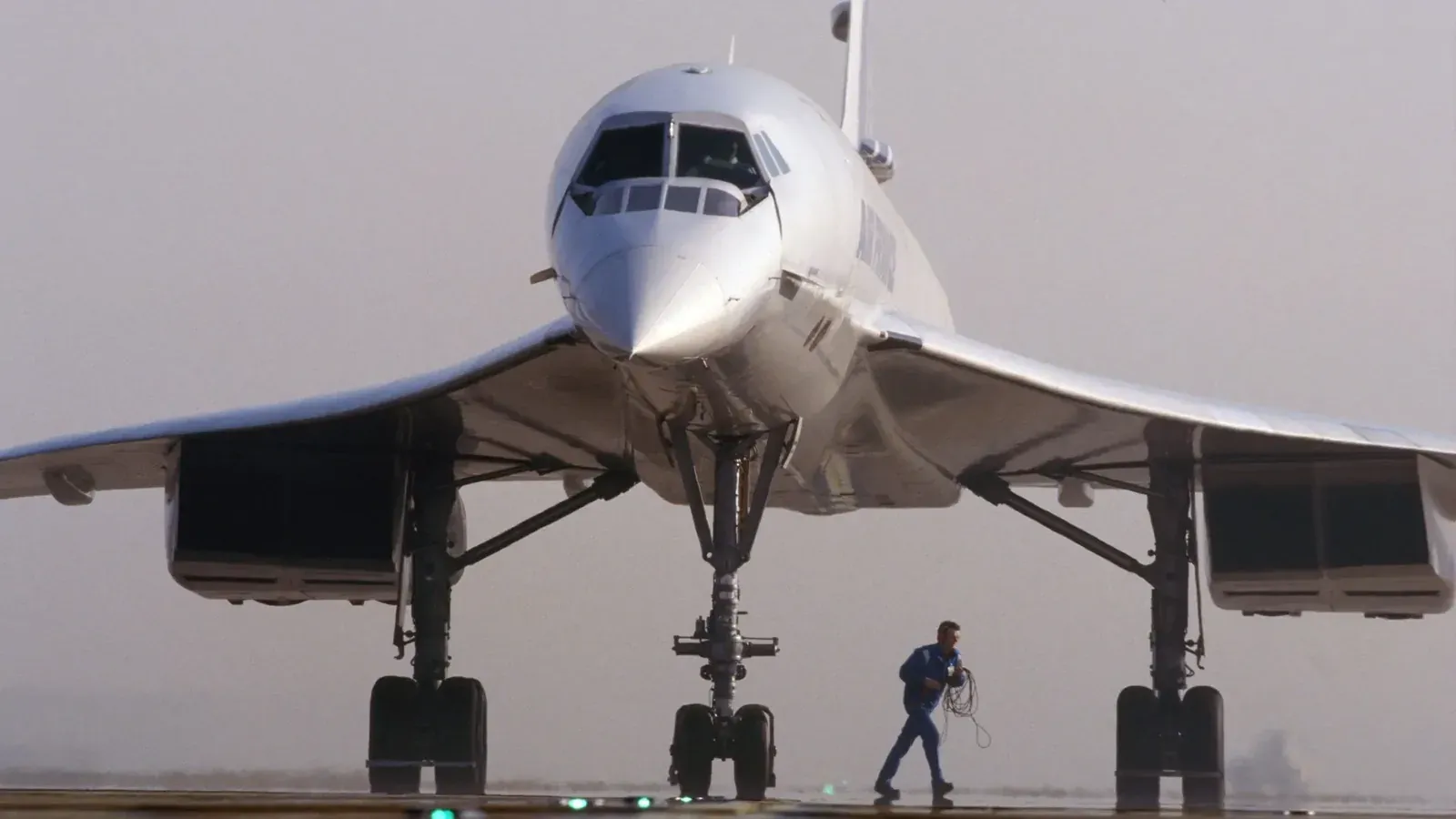
Concorde stopped flying in 2003 because four problems landed at the same time: the 2000 crash near Paris, falling passenger revenue, rising maintenance costs on an aging fleet, and Airbus deciding to end its support. Any one of them might have been survivable, and together they ended supersonic passenger travel.
For twenty-seven years, humans could cross the Atlantic in about three and a half hours, London to New York before your body had fully agreed it was morning. Then, in 2003, we stopped, and we have been slower ever since.
That is the strangest fact in modern aviation, and almost nobody notices it. Passenger flight went backwards. The fastest airliner ordinary money could buy a seat on is now a museum piece, hanging in a hangar with a rope around it, and nothing took its place. Most people, if you ask why Concorde was retired, have a tidy one-word answer: the crash. That is where the real story starts, because the tidy answer is wrong.
What Made Concorde Extraordinary
Concorde entered service on 21 January 1976, built jointly by Britain and France, flown only by British Airways and Air France. It cruised at Mach 2.04, a bit over 1,350 miles an hour, twice the speed of sound, high enough at nearly 60,000 feet that passengers could see the curve of the Earth against black sky. No other airliner has ever come close, before or since.
The number that made it famous was the clock. A normal flight from London to New York took seven or eight hours. Concorde did it in about three and a half, sometimes faster with a good tailwind. The record run, in 1996, landed in New York from London in 2 hours, 52 minutes, and 59 seconds. You could leave London mid-morning and land in New York before lunch had properly started, local time earlier than the time you took off.
None of that came free. The cabin sat barely a hundred passengers in a tube narrower than a regional jet, fares ran into the thousands, and the plane drank fuel at a rate that made accountants wince. A sonic boom trails any aircraft flying faster than sound, a hard double crack loud enough to rattle windows for miles, so countries wouldn’t allow it overland. Concorde could only run flat out over open ocean, which boxed its whole existence into one profitable lane: London and Paris to New York, selling speed and exclusivity to people who’d pay almost anything for both.
The 2000 Crash
On 25 July 2000, Air France Flight 4590 took off from Charles de Gaulle Airport outside Paris, bound for New York. During the roll, it ran over a metal strip lying on the runway, debris that, according to the official investigation, had fallen from another aircraft’s engine on an earlier takeoff. The strip burst a tyre, a piece of rubber slammed into the underside of the wing, and the impact ruptured a fuel tank. The leaking fuel caught fire, and the aircraft came down moments later in Gonesse, just outside the city. All 109 people on board were killed, along with 4 people on the ground.
It was the only fatal accident in Concorde’s history, and because it was Concorde, the whole world watched. The image stuck, and it’s the reason most people assume the crash is the whole answer to why Concorde was retired.
The fleet was grounded, investigated, and modified: tougher tyres, and fuel tanks lined to resist that kind of rupture. Concorde was recertified as airworthy and went back into commercial service in November 2001, carrying paying passengers across the Atlantic exactly as before. It flew for two more years after that. Whatever ended Concorde, the plane itself could still do the thing it was built to do.
Why Was Concorde Retired?
So a recertified, still-flying, one-of-a-kind aircraft stops in 2003. Why was Concorde retired if it wasn’t grounded for cause? A pile-up of reasons, arriving together.
The crash mattered as a wound to confidence. It bruised the mystique right when Concorde needed every advantage it had left.
Then came September 2001. The attacks gutted premium transatlantic travel almost overnight, and premium transatlantic travel was Concorde’s entire business. The exact customers it depended on, people paying top fares to cross the ocean fast, made up the market that cratered and was slow to recover.
Underneath that, the fleet was simply old. Only twenty Concordes were ever built, and by the early 2000s the survivors were pushing thirty years in the air. A small, aging, one-of-a-kind fleet is a maintenance nightmare: every part is bespoke, every hour in the shop is expensive, and there’s no economy of scale to soften the bill.
And then the quiet killer, the part most tellings leave out. Airbus, by then responsible for supporting the aircraft, announced it would stop. Keeping a thirty-year-old plane airworthy takes a manufacturer standing behind it, supplying parts and signing off on the engineering. Once that backing was going away, continuing wasn’t really a choice. British Airways and Air France announced the retirement in April 2003. Air France flew its last commercial Concorde service that May. British Airways kept going a little longer, closing out supersonic passenger service on 24 October 2003, when G-BOAG landed at Heathrow alongside two other Concordes making their own final approach.
Put it together and Concorde’s end reads like a spreadsheet. A brilliant, thirsty, tiny-fleet aircraft on one shrinking route was no longer worth the cost, and three separate forces, safety, economics, and manufacturer support, all landed in the same two years. The math is what grounded planes that could still fly.
Concorde Timeline, 1976 to 2003
| Date | What Happened |
|---|---|
| 21 January 1976 | First commercial flights: British Airways London to Bahrain, and Air France Paris to Rio de Janeiro via Dakar |
| 25 July 2000 | Air France Concorde F-BTSC crashes at Gonesse, near Paris |
| 7 November 2001 | Concorde returns to service |
| 10 April 2003 | British Airways and Air France both announce retirement |
| 31 May 2003 | Air France’s last scheduled Concorde flight |
| 24 October 2003 | British Airways’ last commercial Concorde flights, ending at London Heathrow from New York JFK |
The Plane That Made the Future Feel Closer
When Concorde retired, nothing replaced it. There was no next-generation supersonic airliner waiting in the wings, no successor in flight test, no plan on any drawing board close to ready. The industry just stopped, and dropped back to subsonic, cruising at altitudes that never got anywhere close to the nearly 60,000 feet Concorde used routinely.
Since 2003, every passenger on every scheduled flight has traveled slower than a Concorde passenger did in 1976. The wall we hit was economics: we decided the sums didn’t work and let the capability lapse. A few companies are trying to bring it back, Boom Supersonic chief among them, chasing a new overwater jet with better engines and quieter ambitions. Maybe it works. So far it’s only an attempt, and we’ve heard “supersonic is coming back” before.
For twenty-seven years, people could cross an ocean in about three and a half hours, and then we chose not to. The most extraordinary flying machine ever sold a seat on was slowly, quietly priced out of existence, and we’ve been flying slower ever since without much noticing what we set down.
FAQ
Why Did Concorde Stop Flying? Four problems hit at once. The July 2000 crash of Air France Flight 4590 damaged public confidence, passenger revenue kept falling, maintenance costs on the small, aging fleet rose sharply after its return to service, and Airbus decided not to support the aircraft beyond October 2003. All of it landed within a few years of each other.
When Did Concorde Stop Flying? Air France flew its last scheduled Concorde service on 31 May 2003, and British Airways flew its last commercial flights on 24 October 2003, ending at Heathrow from New York.
When Did Concorde Start Flying Passengers? On 21 January 1976, when British Airways flew London to Bahrain and Air France flew Paris to Rio de Janeiro via Dakar.
What Happened to Concorde After the Crash? Engineers reinforced the tyres and lined the fuel tanks, regulators recertified the aircraft as airworthy, and it returned to paying passenger service in November 2001, flying for two more years before retirement.
Will Supersonic Passenger Flights Ever Return? Possibly. Startups like Boom Supersonic are developing new supersonic airliners aimed at quieter booms and better fuel economy, but as of now nothing is in scheduled commercial service. The skies have stayed subsonic since 2003.
Read next
Largest Passenger Plane in the World: The Airbus A380
The Airbus A380 is the largest passenger plane in the world: 545 seats in a typical layout, 853 certified, and a 262 ft wingspan. How it compares.
AircraftWhy the 747 Has That Hump (It's Not What You Think)
The reason the 747 has a hump isn't styling or a lounge. It's a cargo door, and a bet Boeing made on a future that never arrived.
How Flying WorksWhy Is British Airways Called Speedbird? Callsigns Explained
British Airways is called Speedbird after a 1932 Imperial Airways logo. Here's how that bird became BA's radio callsign, and how callsigns work.
Liked this?
Get the next one in your inbox. Aviation explained for the people who never lost the wonder. One email, no noise.