
Why Some Planes Leave Trails and Others Don't
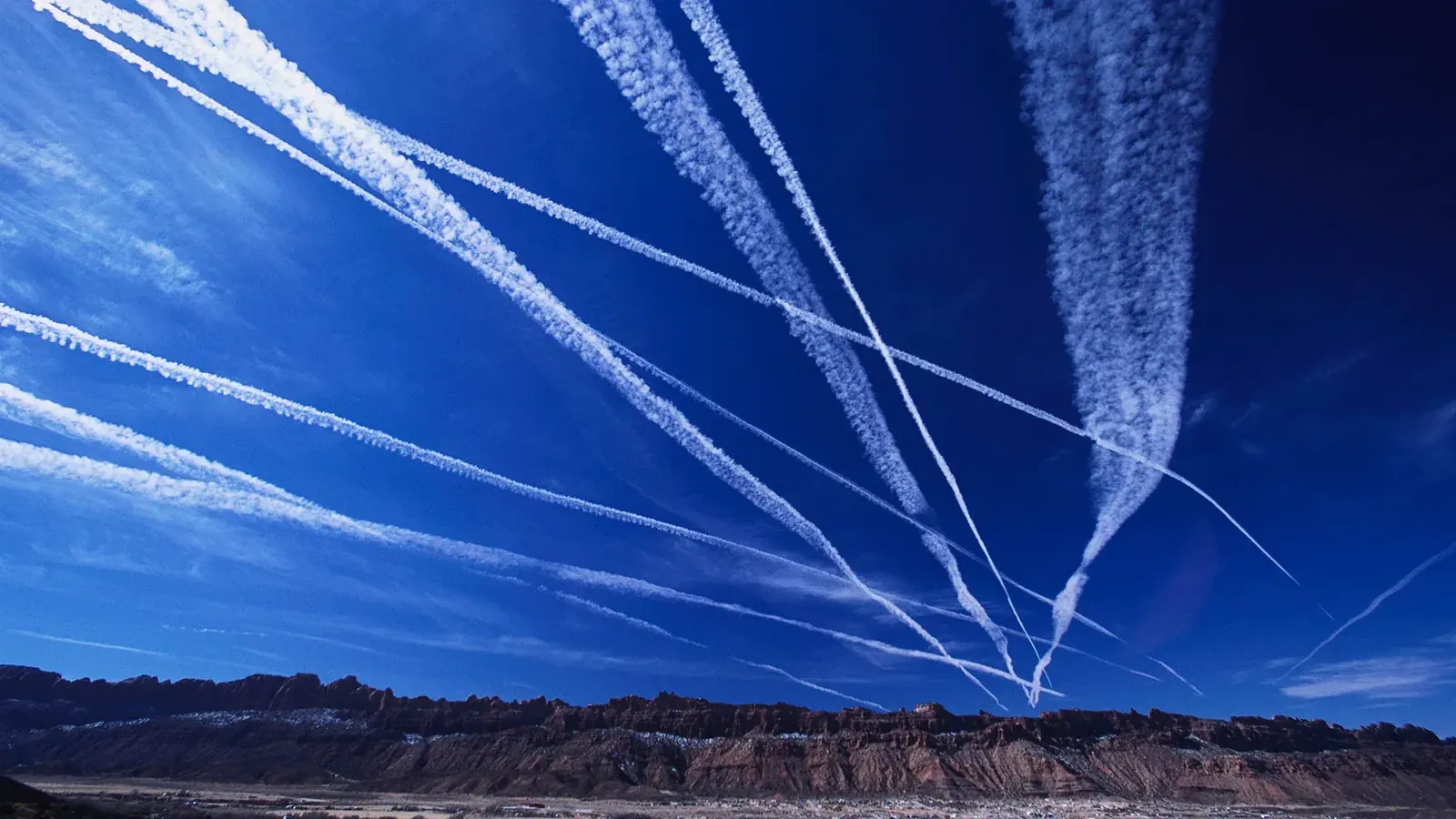
A plane leaves a trail when the water vapor in its hot exhaust freezes into ice crystals, and the trail only lasts when the surrounding air is cold and humid enough. In drier air the ice turns back into vapor within seconds to minutes, so the same jet leaves a short trail or none at all.
Two jets cross the same patch of sky, a minute apart. One drags a long white scar for miles behind it. The other leaves nothing, just clean blue where it passed. Same afternoon, roughly the same altitude.
Neither plane is broken, and neither is doing anything special. They’re just each flying through their own pocket of air, and those two pockets aren’t nearly as similar as they look from the ground.
Why do planes leave trails at all?
Start with what that white line actually is, because most people guess wrong on the first try. It isn’t smoke. It isn’t a chemical being sprayed. It isn’t fuel getting dumped.
A jet engine burns fuel, and like any engine that burns fuel, its exhaust is full of hot water vapor. At ground level that vapor just vanishes into the air around you. Cruising altitude is a different planet. Up around 35,000 feet, the air outside the cabin window sits somewhere near minus 50 degrees Celsius. Dump hot, humid exhaust into air that cold and the water vapor doesn’t get a say in the matter. It condenses and freezes almost instantly, turning into a stream of tiny ice crystals trailing behind the engines. Inside that same cabin, the air sits at a lower pressure than the ground, which is the same reason your ears pop on the climb.
That’s a contrail, short for condensation trail, and for once the plain name is the accurate one: a manmade cloud, built from the same stuff as any other cloud, ice, just triggered by an engine instead of a weather front. Every jet at cruise altitude is doing this. The real question isn’t why do planes leave trails. It’s why don’t they all show it.
Same sky, different air
Which brings you back to that second plane, the one flying clean.
Making a contrail takes two things happening together: cold enough air, and moist enough air. Cruise altitude almost always covers the cold part. Above roughly 26,000 feet, it’s cold enough for ice nearly everywhere on Earth, on any given day. The part that isn’t guaranteed is the moisture.
If the air a plane is punching through happens to be dry, the ice crystals form for a fraction of a second and then flash straight back into invisible vapor, sublimating away before your eye ever catches them. No visible trail, even though the exact same physics just happened up there. Shift a plane a few thousand feet up or down, or send it along a flight path a few miles to one side, and it can cross into air that’s slightly warmer or slightly drier. No contrail, or one that disappears the instant it forms.
Same sky to you. Two different worlds to them.
Why some trails vanish and others hang around for hours
This is also what explains the two very different trails you’ve probably noticed: the ones that fizzle out in seconds, and the ones that spread wide and drift for what feels like the whole afternoon, sometimes fanning out until they look like a thin sheet of cloud.
It comes down to humidity again, just in a different role, the same deciding factor the FAA’s contrails fact sheet points to for whether a trail fades or lingers. In dry air aloft, a contrail’s ice crystals sublimate back into vapor almost as fast as they formed, so the line disappears behind the plane nearly as quickly as it was drawn. In humid air aloft, the opposite happens. The ice crystals have nowhere to evaporate to, because the surrounding air is already close to saturated, so they survive, grow, and get pushed apart by the wind at cruising altitude. That’s a persistent contrail, and given enough moisture up there it can spread into a hazy layer that lingers for hours, drifting far from the flight path that made it.
Wait, isn’t that a chemtrail?
No, and this one’s worth answering straight instead of rolling your eyes at it. “Chemtrail” is the idea that those long-lasting, spreading trails are secretly some kind of chemical or biological spraying program, hidden behind ordinary contrails as cover. It isn’t true, and it’s been checked directly. Atmospheric scientists, including a published survey of the world’s leading atmospheric chemists and geochemists, have looked at the claimed evidence and found nothing beyond what the physics already predicts: contrails sitting in a humid layer of air, doing exactly what humid air makes ice crystals do. A persistent trail isn’t secret evidence of anything. It’s just a contrail with better conditions to work with.
Next time you look up
Watch a contrail closely sometime and you can catch something else: a trail that flicks on, off, on again, a dashed line instead of a solid one, as the same plane threads through pockets of air that keep switching between moist enough and not. The plane isn’t doing anything different from one second to the next. You’re just watching the invisible texture of the sky get written out in ice, one pocket of air at a time. And once you’re already looking up, it’s worth learning to tell the planes themselves apart.
FAQ
Are Contrails and Chemtrails the Same Thing? No. Contrails are well-documented condensation trails made of ice. “Chemtrail” is an unfounded theory with no supporting evidence behind it.
How High Does a Plane Need to Be Flying to Leave a Contrail? Generally at cruise altitude, roughly 26,000 feet and above, where the air is reliably cold enough. Below that, it usually isn’t cold enough no matter how humid the air is.
Why Does a Contrail Sometimes Disappear Almost Instantly? Dry air. The ice crystals form for a moment and then sublimate straight back into invisible vapor because there’s no spare moisture around to let them stick.
Read next
Why Is British Airways Called Speedbird? Callsigns Explained
British Airways is called Speedbird after a 1932 Imperial Airways logo. Here's how that bird became BA's radio callsign, and how callsigns work.
How Flying WorksHow High Do Planes Fly? Cruising Altitude, Explained
Most airliners cruise between 31,000 and 42,000 feet, often near 35,000 feet, about 10.7 km up. Here's why that band exists and what caps it.
How Flying WorksWhat Does Mayday Mean? Origin, Pan-Pan and Squawk 7700
Mayday is the radio call for grave and imminent danger, said three times. Where the word comes from, plus what pan-pan, heavy, and squawk really mean.
Liked this?
Get the next one in your inbox. Aviation explained for the people who never lost the wonder. One email, no noise.