
Why Is Flying East Faster? The Jet Stream, Explained
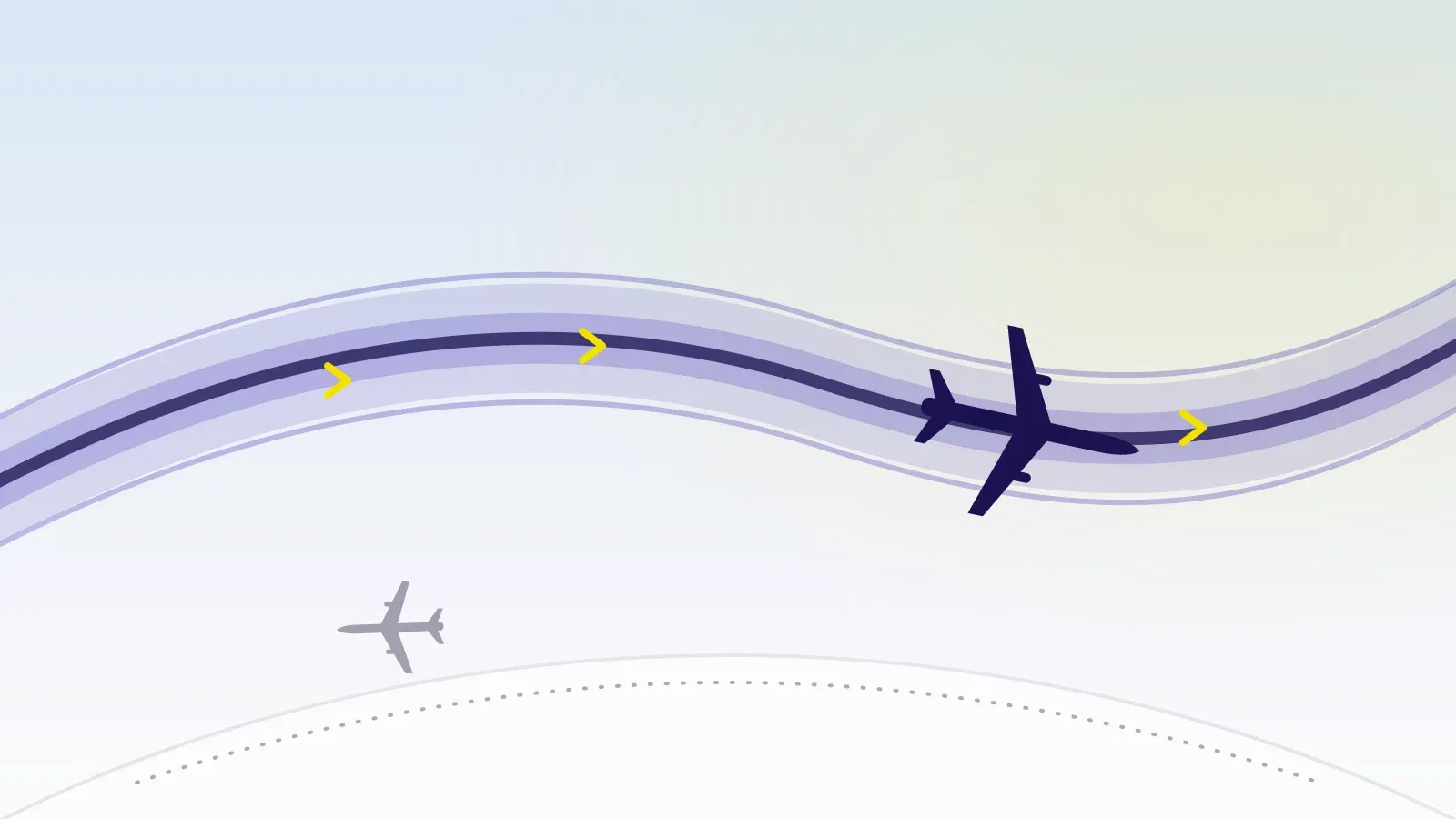
Flying east is usually faster because of the jet stream, a band of strong wind high in the atmosphere that blows from west to east. Head east and your jet rides it like a moving walkway at the airport. Head west and it walks into the same wind. On New York to London, that’s typically about an hour’s difference: roughly seven hours over, closer to eight coming back.
On a wild day the gap gets much bigger. In February 2020, with Storm Ciara pushing the jet stream to extreme speeds, a British Airways 747 flew New York to London in 4 hours and 56 minutes, touching 825 mph over the ground. No subsonic airliner had ever made that crossing faster.
A river of wind at cruising height
The jet streams sit around 30,000 to 40,000 feet, right where airliners cruise. EUROCONTROL’s SKYbrary puts a typical core speed at around 100 knots, reaching 200 knots over North America and Europe in winter. That’s a hurricane-strength wind, blowing steadily, six miles up, and its ragged edges are where clear-air turbulence brews.
They form where cold polar air meets warmer air from the tropics. The sun heats the equator far more than the poles, the atmosphere keeps trying to even that out, and the Earth’s spin bends the resulting flow toward the east. The sharper the temperature contrast, the stronger the wind, which is why the jet stream is at its fiercest in winter and why the winter schedule between Europe and America often builds in a bit more time for the westbound leg.
You may have heard that the Earth’s rotation itself speeds up eastbound flights. It doesn’t, directly. The plane, the air around it and the airport it’s heading for are all already moving with the planet. The spin’s real role is behind the scenes, steering the winds into that west-to-east river.
What a tailwind is worth
A plane has two speeds. Airspeed is how fast it moves through the air around it. Ground speed is how fast it covers the map. In still air they match. Put the whole air mass in motion and they split apart.
Take a jet cruising at about 480 knots through the air. With a 100-knot tailwind, it covers ground at 580 knots. With the same wind on the nose, it’s down to 380. Across the roughly 3,000 nautical miles between New York and London, that’s the difference between a bit over five hours and nearly eight. Real flights don’t sit in the core of the jet the whole way, and the wind changes along the route, so the everyday gap shrinks to around an hour. On a record day it opens right up.
That 825 mph BA flight never broke the sound barrier. Through the air around it, the 747 was flying at an ordinary cruise speed; the extra 200-plus mph was the air itself carrying it along. The airspeed converter shows how true airspeed and Mach behave at cruise height, and every bit of tailwind lands on top of that.
Airlines redraw the ocean every day
Over the North Atlantic, flights don’t follow fixed highways. Twice a day, oceanic controllers publish a fresh set of parallel routes called the North Atlantic Tracks: Shanwick, run from Ireland and the UK, draws the daytime westbound set, and Gander in Canada draws the overnight eastbound set. Each set is shaped around that day’s winds.
Eastbound tracks get laid right along the jet stream core to soak up the tailwind. Westbound tracks are drawn to dodge it, sometimes swinging far north over Greenland or well south toward the Azores, even though that strays from the great circle, the shortest path on a globe. A longer line with less wind in your face can still be the faster trip.
The same thing plays out over the Pacific, where the jet stream off Japan is one of the strongest on the planet. Tokyo to Los Angeles runs around ten hours. Los Angeles to Tokyo is closer to twelve.
What it means for your trip
The eastbound overnight to Europe is shorter, which sounds like good news until you notice it also shortens your night. You take off after dinner, eat again, and land at breakfast time with four or five hours of sleep at best. Eastbound travel is generally the harder direction for jet lag too, because your body clock has to run forward, and the jet lag calculator will give you a plan for that.
For any route, the flight time calculator gives you the still-air baseline. The jet stream is what pulls the real schedule either side of it, a little early one way and a little late the other, depending on which way the wind is blowing six miles over your head.
FAQ
Why is flying east faster than flying west? Because of the jet stream, a band of strong wind at cruising altitude that blows from west to east. Eastbound flights ride it as a tailwind and cover more ground per hour. Westbound flights face it as a headwind, or route around it.
How much faster is flying east? Across the Atlantic, usually about an hour. New York to London takes around seven hours and the return closer to eight. Across the Pacific the gap can be two hours, with Tokyo to Los Angeles around ten hours and the return closer to twelve.
Does the Earth’s rotation make flying east faster? Not directly. The plane, the air and the airports all rotate with the planet. The rotation matters indirectly, by steering the winds into the west-to-east jet streams that do speed eastbound flights up.
What is the fastest subsonic flight from New York to London? A British Airways Boeing 747 made it in 4 hours and 56 minutes in February 2020, riding jet stream winds from Storm Ciara and reaching a ground speed of 825 mph.
Is the jet stream stronger in winter? Yes. It’s driven by the temperature difference between polar and tropical air, which is greatest in winter. Over North America and Europe, winter jet stream winds can reach 200 knots.
If the next flight home feels long, now you know who to blame. Sign up for the newsletter for more of the sky explained.
Read next
Longest Flight in the World 2026: JFK to Singapore, 18h 50m
The longest flight in the world right now is Singapore Airlines' New York JFK to Singapore: 15,350 km in 18h 50m on an A350-900ULR. See the 2026 top five.
Routes & NetworksWhy Airlines Fly Empty Planes on Purpose
Airlines fly near-empty planes to keep airport slots, and a Heathrow slot pair has sold for about $75 million. How the 80/20 rule makes ghost flights happen.
Routes & NetworksWhat Is the Busiest Airport in the World? (2026)
What is the busiest airport in the world? Atlanta, by a wide margin, moving over 106 million passengers a year. Here's why, and who's closing in.
Liked this?
Get the next one in your inbox. Aviation explained for the people who never lost the wonder. One email, no noise.