
Why Your Window Seat Sometimes Has No Window
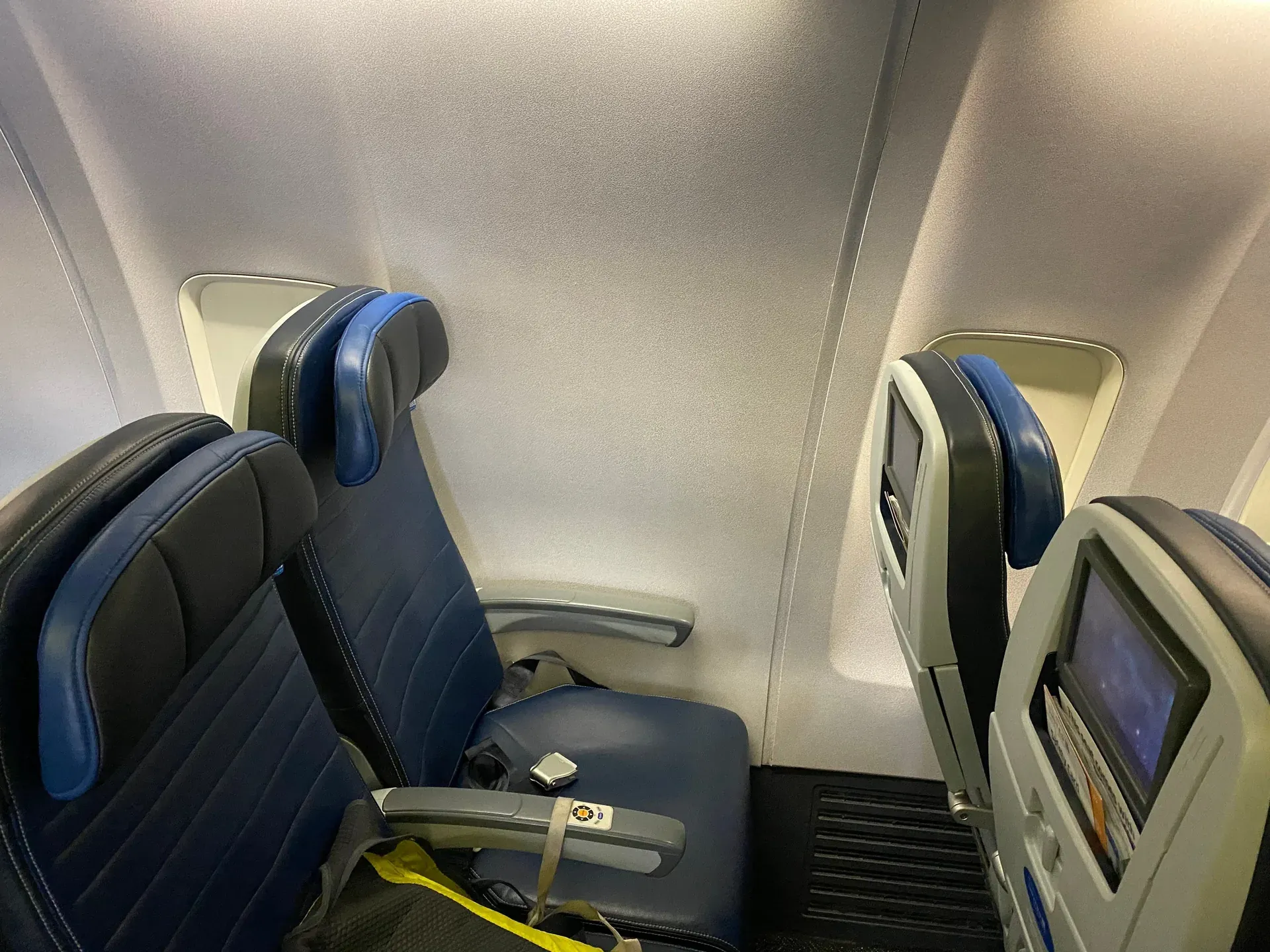
You picked the window seat. Maybe you paid extra for it. You board, find your row, sit down, and there’s no window. Just a smooth stretch of plastic wall where the glass should be.
It happens often enough that photos of it go viral every few months. In 2025 it went further than annoyed posts online. Passengers filed lawsuits against United and Delta over “windowless window seats,” alleging the airlines let them pay extra to choose a window seat and never flagged that the seat had no window. Those are filed claims and passenger allegations, not settled cases. But they put a real number on the frustration, and they raise the obvious question. How does a window seat end up with no window?
The short version: windows don’t move, seats do
Windows are cut into the fuselage when the plane is built, at a fixed spacing, roughly one every 20 inches or so along the length of a typical jet. (That oval shape is its own story, and a life-or-death one.) The spacing is baked into the metal. It’s the same on every plane of that type as it rolls off the line, and it never changes.
Seats are a different story. Rows are spaced by seat pitch, the distance from one seat to the same point on the seat in front. The airline chooses the pitch, and over the years it’s crept down as carriers add rows to sell more tickets. Economy pitch is often 30 or 31 inches now, sometimes less.
So you’ve got two rulers that don’t match. The windows tick along at one spacing, the seats at another. Line them up at the front of the cabin and they start together, then slowly drift apart. A few rows back, your seat no longer sits under a window. It sits beside the gap between two of them, or against a solid piece of wall with no window at all.
Why the Embraer E175 is the poster child
The E175 is the plane people mean when they complain about this. There’s a reason it turns up again and again.
Embraer laid out the E-Jet’s windows for a roomier cabin than the one most airlines actually fly. The glass was spaced for a wider seat pitch, back when the plan was a comfortable single-class layout. Then reality arrived. Airlines carve the cabin into a first-class section up front, an extra-legroom section behind it, and a tighter economy pitch in the back. Each of those choices shifts the rows relative to the fixed windows, and the misalignment stacks up. Whole rows fall out of sync. On some E175 layouts, a row near the middle of the cabin lands on a genuine blank wall.
It isn’t every E-Jet. The smaller E145 and E170 generally keep a window at every window seat. It’s the E175, packed into a dense two-class layout, where the drift shows up worst. People who booked a window seat on one have reported sitting down to find plain cabin wall instead. Which exact rows depends on the airline, so there’s no single row to memorize that works everywhere.
A different jet, a different reason
The Embraer story is about rows drifting out of line. On other planes, a window is simply left out on purpose.
On the Airbus A320 and A321, and on the Boeing 737, you’ll sometimes find one window missing from an otherwise even run of them. That’s usually because something sits behind that exact spot in the wall: air-conditioning ducting, a bundle of wiring, or a structural joint where two sections of fuselage meet. You can’t cut a window-sized hole through a duct run or a load-bearing joint, so the window just isn’t there.
Same symptom, two separate causes. One is the seats and windows falling out of step. The other is a patch of fuselage that was never going to carry a window in the first place.
Why a row number won’t save you
Here’s the frustrating part. You can’t memorize a magic row to avoid.
The blank-wall rows depend entirely on the exact cabin the airline flew that day. The same aircraft type, an E175, run by two different airlines can have its missing windows in completely different places, because they chose different cabins. A row number you found on a forum is a hint at best. The only layout that counts is the one for your specific flight.
The good news is you can check it. Pull up the seat map for your exact flight and aircraft before you pay. Independent tools like SeatGuru and aeroLOPA document window gaps plane by plane, down to which seats have no glass beside them. Many airline booking screens now flag it directly, marking a seat “no window” or “limited/misaligned window.” Look for a window seat with nothing drawn next to it. That’s the tell. If you still can’t tell, call the airline with your flight number and seat and ask.
The part nobody warns you about
Before you swap that seat in a panic, one thing worth knowing. The blank wall isn’t all bad.
Some frequent flyers pick it on purpose. A solid wall is a better thing to lean your head against for a nap than a cold window and its curved frame. It stays cooler than the glass, and there’s no sun blasting into your eyes at 38,000 feet. One journalist who booked a windowless window seat deliberately came away calling it a quietly excellent place to sleep.
It’s worth remembering what the E-Jets get right, too. There’s no middle seat on them. The cabin is a 2-2 layout, so every single seat is either a window or an aisle, and the seats themselves are wide. You might lose the view on one row out of the whole plane. You’ll never end up wedged in the middle. For a small jet flying the short hops nobody used to look forward to, that’s a pretty good deal, wall or no wall.
Read next
Why Is British Airways Called Speedbird? Callsigns Explained
British Airways is called Speedbird after a 1932 Imperial Airways logo. Here's how that bird became BA's radio callsign, and how callsigns work.
How Flying WorksHow High Do Planes Fly? Cruising Altitude, Explained
Most airliners cruise between 31,000 and 42,000 feet, often near 35,000 feet, about 10.7 km up. Here's why that band exists and what caps it.
How Flying WorksWhat Does Mayday Mean? Origin, Pan-Pan and Squawk 7700
Mayday is the radio call for grave and imminent danger, said three times. Where the word comes from, plus what pan-pan, heavy, and squawk really mean.
Liked this?
Get the next one in your inbox. Aviation explained for the people who never lost the wonder. One email, no noise.