
What Do the Numbers on a Runway Mean? A Decoder You'll Actually Use
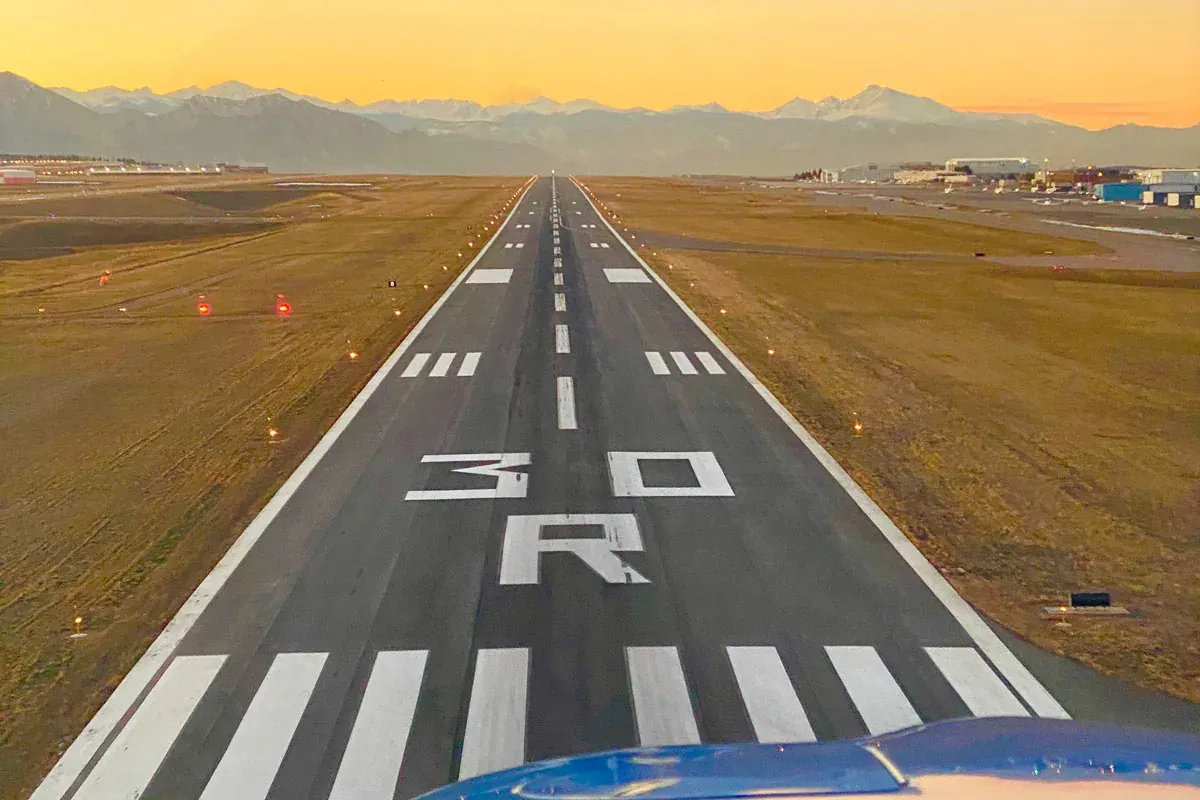
Runway numbers are the runway’s magnetic compass heading, rounded to the nearest 10 degrees and divided by 10: runway 27 points about 270 degrees, which is west. The other end points the opposite way, so a runway marked 27 at one end is 9 at the other.
You’ve seen it from your window seat a hundred times: a massive white number at the end of the runway, growing bigger as the wheels come down. 27. 9. 14. That number is a compass heading hiding in plain sight, and once you know the trick you can stand at the fence and read the direction a plane is about to land before the tires touch.
Why Do Runways Have Numbers in the First Place
Every runway points somewhere, literally: it’s a strip of asphalt aimed at a specific compass direction, and pilots need to know that direction instantly, without doing mental math on approach. So airports paint a shorthand version of the heading on the pavement.
The FAA’s definition is precise: the runway number is the whole number nearest one-tenth of the runway’s magnetic heading, measured clockwise from magnetic north. In plain terms, that’s the heading rounded to the nearest ten degrees, with the last digit dropped. A runway pointing roughly 090 degrees, due east, gets painted 9. One pointing roughly 270 degrees, due west, gets painted 27. Runway numbers explained in one sentence: take the heading, lose the zero, paint it big enough to read from the cockpit.
How are runways numbered, full stop? Off a compass. The number is a plain heading, sized to be read from a cockpit going 150 miles an hour.
- Compass: north at the top, 270 degrees is west.
- East end of the runway: painted 27, for aircraft landing heading west (270 degrees).
- West end of the runway: painted 9, for aircraft landing heading east (090 degrees).
- Northern parallel runway: 27R at the east end, 9L at the west end.
- Southern parallel runway: 27L at the east end, 9R at the west end.
Why Every Runway Has Two Numbers
Here’s the part that makes it click. Planes land and take off from either end of a runway, depending on which way the wind is blowing. So every runway carries two numbers, one painted at each end, always exactly eighteen apart. Both the number and any letter come from the direction you approach: land heading west and the 27 is painted at the east end, the end you cross first.
The math is simple. Walk to the opposite end of any straight line and you’re facing the exact opposite direction, 180 degrees around, and 180 divided by 10 is 18. Land heading 270 and you’re on Runway 27. Turn around, take off the other way heading 090, and you’re on Runway 9. Same strip of concrete, two different numbers, because it’s two different directions. Numbers run from 1 up to 36, covering the full circle of a compass.
The Letters: L, C, and R
Big airports often build runways side by side, pointing the exact same direction. That’s a problem: they’d all want the same number. The fix is a letter tacked on the end. L for left, R for right, and at the handful of airports with three parallel runways, C for the one in the center.
The letter flips at the far end, too. Facing west, the southern runway of a pair is on your left, so it’s 27L. Turn around to face east and that same strip is on your right, so it’s 9R.
A controller clearing a jet for “two-seven left” is telling that pilot exactly which of the side-by-side runways to use, all sharing the same underlying heading. It’s the same decoder trick as the aircraft registration painted on the tail: once you know what the code is built from, the plane in front of you stops being a mystery.
The Twist: Runways Get Renumbered
Here’s the part almost nobody expects. Runway numbers are built on magnetic north, and magnetic north drifts year after year, a shift charted in NOAA’s magnetic-field records, dragging every compass heading on Earth with it. The runway stays put, and the number painted on it describes an angle relative to magnetic north. When that drift adds up to a few degrees, the old number stops matching reality.
Once the drift crosses into the next ten-degree bracket, the airport has to repaint. Berlin Brandenburg Airport did exactly this on October 3, 2024: its two runways, previously 07L/25R and 07R/25L, became 06L/24R and 06R/24L, because magnetic north had crept far enough to flip which heading bracket each one fell into. The concrete stayed exactly where it was while the compass reference underneath it shifted.
Canada sidesteps the problem in its far north. Canada’s own guidance says that in its Northern Domestic Airspace, runway headings and tracks are given in degrees true, measured from the geographic North Pole, because magnetic compasses are unreliable that close to the magnetic North Pole.
It’s happened before, at airports from Tampa to Las Vegas, and it’ll keep happening, slowly, wherever runways are numbered off magnetic north. A runway number is a snapshot of where magnetic north happened to be the last time someone got the paint out.
Reading Real Runways
Renumbering comes around more often at high latitudes, and Fairbanks International in Alaska shows it best. In 2009 its runway 1L/19R became 2L/20R, and the airport expects to repaint again around 2033.
Denver shows how close to the line a runway can sit. Its runway 17L/35R sits at 172.5 degrees. If that bearing reaches about 176 degrees, the same strip becomes 18L/36R.
Next Time You Land, Call It First
Next flight, watch for the number as the runway comes into view. Multiply it by ten and you know the heading the plane is about to touch down on, and an L, C, or R tells you exactly which of the parallel strips you’re on. Read the number, call the direction, watch the wheels prove you right.
FAQ
What Do the Numbers on a Runway Mean? They’re the runway’s magnetic compass heading, rounded to the nearest ten degrees with the final zero dropped. Runway 9 points roughly east (090 degrees), Runway 27 points roughly west (270 degrees).
Why Do Some Runways Have Letters Like L and R? Busy airports build parallel runways pointing the same direction, so they’d otherwise share a number. L, C, and R (left, center, right) tell pilots and controllers which of the parallel strips is meant.
Why Do Runways Sometimes Get Renumbered? Because the numbers are based on magnetic north, and magnetic north drifts a little every year. Once that drift pushes a heading into a new ten-degree bracket, the airport repaints the numbers to match, the way Berlin Brandenburg did in 2024.
Why Do the Two Numbers on the Same Runway Always Differ by 18? Because the two ends point in exactly opposite directions, 180 degrees apart, and 180 divided by the ten-degree rounding used for runway numbers is 18.
Why Is 27L the Same Runway as 9R? Runway numbers and letters both come from the direction you approach. Land heading west on the southern runway of a parallel pair and it sits on your left, so it’s 27L. Land on that same strip heading east and it sits on your right, so it’s 9R. Turning around swaps left and right.
Do Runway Numbers Ever Change? Yes. Magnetic north drifts, and when a runway’s magnetic heading creeps into a new ten-degree bracket, the airport repaints it. Fairbanks International in Alaska changed runway 1L/19R to 2L/20R in 2009 and expects another change around 2033.
Read next
Why Is British Airways Called Speedbird? Callsigns Explained
British Airways is called Speedbird after a 1932 Imperial Airways logo. Here's how that bird became BA's radio callsign, and how callsigns work.
How Flying WorksHow High Do Planes Fly? Cruising Altitude, Explained
Most airliners cruise between 31,000 and 42,000 feet, often near 35,000 feet, about 10.7 km up. Here's why that band exists and what caps it.
How Flying WorksWhat Does Mayday Mean? Origin, Pan-Pan and Squawk 7700
Mayday is the radio call for grave and imminent danger, said three times. Where the word comes from, plus what pan-pan, heavy, and squawk really mean.
Liked this?
Get the next one in your inbox. Aviation explained for the people who never lost the wonder. One email, no noise.