
What Causes Turbulence, and Why It Won't Bring a Plane Down
The seatbelt sign dings on with no warning, the cabin crew cut the service short and strap in, and the plane starts jumping like a car on a washboard road. Your stomach drops with it. So what causes turbulence on a plane, and is any of it actually a problem?
Here’s the answer up front, because it’s the part that matters most: turbulence is air in motion, nothing more. The plane isn’t struggling through anything. You, unbelted, are the one it can actually hurt.
What turbulence actually is
Air isn’t the still, empty backdrop it looks like from your window seat. It moves in currents, layers, and eddies, the same way water does, just invisibly. Turbulence is simply irregular movement in that air: pockets moving at different speeds or directions bumping into each other. A plane flying through it gets jostled the way a boat gets jostled crossing a wake, because it’s riding on a fluid that isn’t behaving smoothly for a moment.
Nothing about that means the plane is failing. The wings, engines, and fuselage are still doing exactly what they were built to do. What changed is the air underneath them. The machine is unaffected.
The handful of things that stir up the air
Turbulence isn’t one mystery phenomenon. It’s a short list of ordinary causes, the ones laid out in the FAA’s turbulence guide, and pilots see all of them coming, except one.
Rising warm air. On a sunny afternoon, the ground heats unevenly: a parking lot warms faster than a lake, a plowed field faster than a forest. Warm air rises off the hot patches in invisible columns, called thermals, and cooler air sinks to replace it. Fly through that patchwork at low altitude and you feel every column as a jolt. It’s the same air a hawk rides to climb without flapping, just less pleasant at 250 knots.
Mountains and terrain. Wind doesn’t stop at a ridge line, it flows over and around it, the way a stream breaks into ripples around a rock. That disturbed air, called mechanical turbulence, can extend for miles downwind of mountain ranges, which is why flights near the Rockies or the Alps get a reputation for bumps.
Storms. Thunderstorms are turbulence factories, with violent updrafts and downdrafts inside and rough air for miles around the edges. This is the one cause pilots actively route around rather than fly through, using onboard weather radar to see storm cells well before arrival.
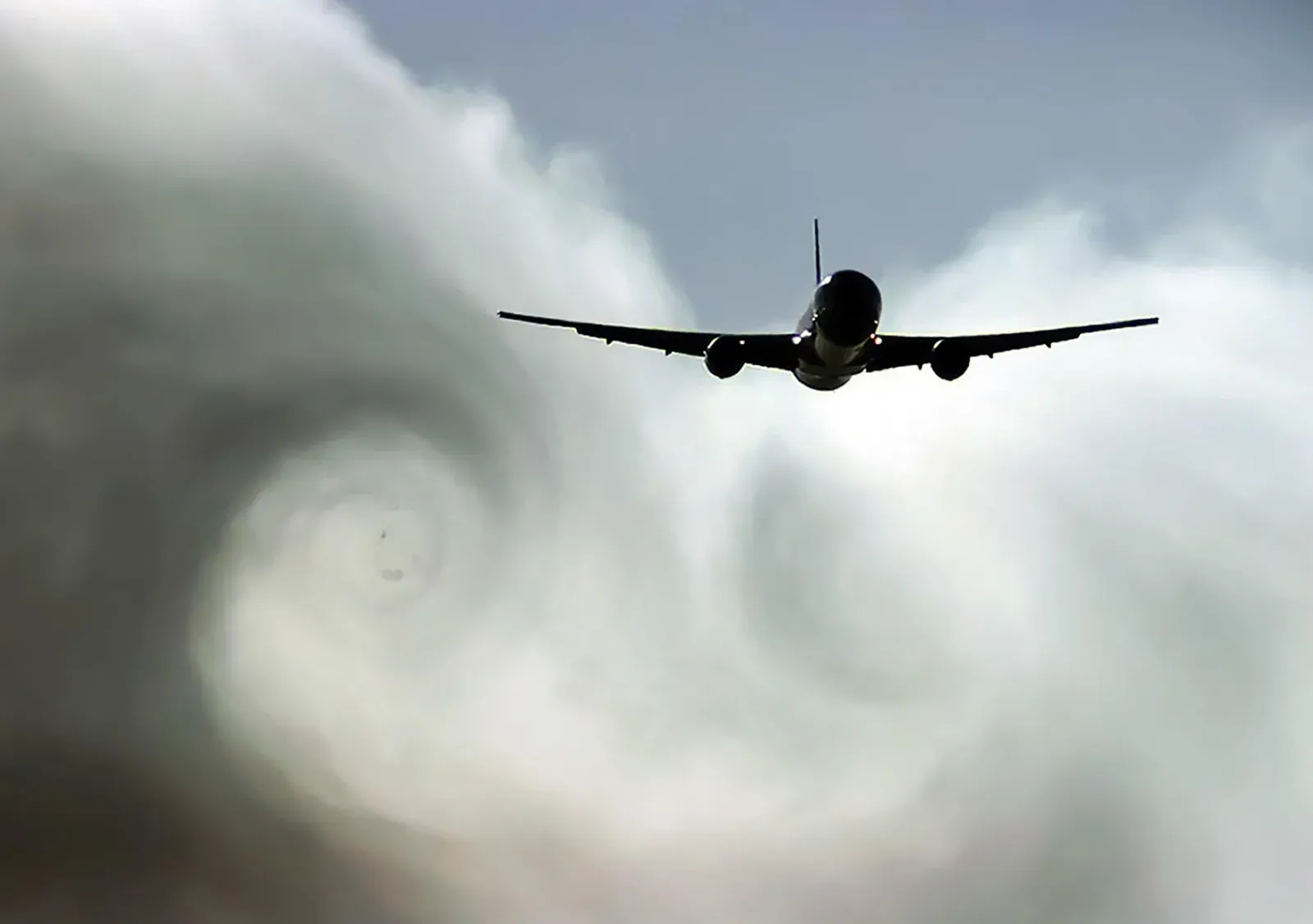
Wake from other planes. Every wing generates a pair of spinning vortices off its tips, invisible funnels of rotating air trailing behind it like a boat’s wake. Fly through one from a jet ahead of you and you’ll feel a jolt. It’s exactly why air traffic control spaces planes out and holds smaller aircraft further back behind heavier ones.
Clear-air turbulence. This is the sneaky one, and the one behind most of the bumps that catch a cabin by surprise. It shows up near the jet stream, the river of fast-moving air many airliners cruise close to, where air masses moving at very different speeds rub against each other. It carries no cloud, no radar signature, nothing a pilot can see out the window or on a screen. Crews rely on forecasts, reports radioed in from other flights ahead, and a fair bit of experience to avoid it, but it can’t always be predicted. Some research suggests it’s becoming more common as the atmosphere warms and the jet stream’s wind patterns shift, though the numbers are still being refined.
That’s the honest answer to “types of turbulence”: thermal, mechanical, storm-related, wake, and clear-air. Different causes, same effect: a bumpy ride that the aircraft shrugs off every time.
Why the plane handles it so easily
This is the part worth actually knowing, because it’s the part that should calm you down.
Airliners are certified to withstand loads far beyond anything turbulence has ever thrown at one. Engineers test wings by bending them upward on a rig until they crack, and the break point sits well past anything a storm or a jet stream will ever demand in service. The flex you sometimes see out the window, a wingtip bobbing gently up and down, isn’t a wing struggling. It’s a wing doing its job: built to bend on purpose. A rigid wing would be the risky design here. A flexible one is the safe bet.
Turbulence, even the rough kind, is measured in a small fraction of the stress the airframe is built to shrug off. Modern airliners don’t get knocked out of the sky by it. They ride through it, sometimes uncomfortably, and land on schedule.
The sky does this. The plane just rides it out
So is turbulence dangerous? To the aircraft, essentially never. To you, only if you’re standing up or unbuckled when it hits. The FAA has found that the overwhelming majority of turbulence injuries happen to passengers who weren’t wearing their seatbelt, usually because the sign had been off for a while. That’s the same everyday habit that matters more than seat selection ever will: keep the belt fastened whenever you’re in your seat, sign on or off. It’s the sky moving under you, and the aircraft was built to ride through exactly that.
FAQ
What causes turbulence on a plane? Irregular movement in the air: rising warm air on hot days, wind disturbed by mountains and terrain, storms, wake vortices trailing off other aircraft, and clear-air turbulence near the jet stream, which is invisible and the hardest kind to forecast.
Is turbulence dangerous? Not to the aircraft. Airliners are built with structural margins far beyond anything turbulence produces. It’s a discomfort problem for passengers, which is exactly why the seatbelt sign exists.
Can turbulence flip or crash a plane? No. Turbulence essentially never brings down a modern airliner. Planes are designed and certified to fly straight through it, and pilots additionally route around the roughest patches, like thunderstorms, whenever they can see them coming.
Why do wings flex so much in turbulence? On purpose. Wings are engineered to bend and absorb loads rather than stay rigid, which is what makes them strong. Watching a wingtip flap gently is watching the design work exactly as intended.
Read next
The Safest Seat on a Plane, According to the Data
The safest seat on a plane, according to decades of crash data, and the honest reason it matters far less than you'd think.
Incidents & SafetyThe Black Box Isn't Black (and It Isn't One Box)
Why is the black box orange, what does the black box record, and who invented it? The answer is a moving story most people never hear.
Incidents & SafetyWhy Flying Keeps Getting Safer: The Hidden System
Why flying keeps getting safer isn't luck. It's a system that treats every accident as a lesson to learn from, not a person to blame.
Liked this?
Get the next one in your inbox. Aviation explained for the people who never lost the wonder. One email, no noise.