
The Black Box Isn't Black (and It Isn't One Box)
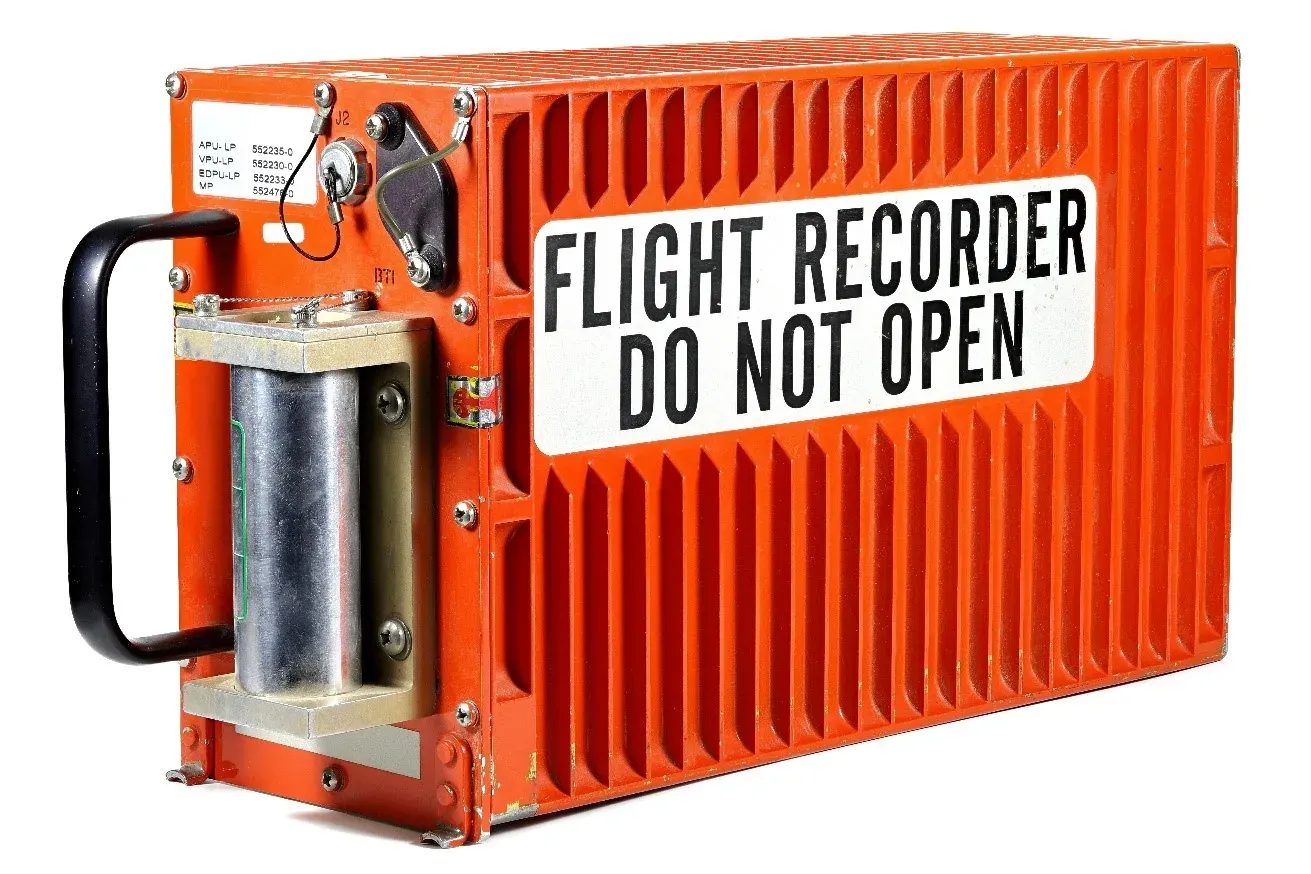
Picture the thing investigators carry out of a crash site. Most people see a charred black cube, scorched and dented, pulled from a field of wreckage. It’s the image the name gives you: a black box, grim and secretive, the last dark artifact of a bad day.
Almost none of that is right. The device is bright orange. There are two of them, not one. And the story of who built it, and why, is one of the most quietly moving stories in aviation. It starts with a boy who lost his father, and it very nearly didn’t happen at all.
It’s orange, and there are two of them
The color first, because it’s the fastest way to break the spell. Flight recorders are painted a vivid, unmissable shade called international orange. The whole point is to be found. When a plane comes apart, the recorders can end up buried in debris on land or scattered across a seabed, and the last thing you want is a black object hiding in a black scene. So they’re the color of a traffic cone, often with reflective stripes, built to catch a searchlight or a diver’s torch. A black box that was actually black would be a design failure.
Now the second surprise: it isn’t one device. It’s two, doing very different jobs.
The Flight Data Recorder, the FDR, is the numbers. It logs the hard facts of the flight, moment by moment: altitude, airspeed, heading, engine settings, the position of the controls, and a long list of other readings. In the United States, newer recorders are required to capture at least 88 separate parameters, many of them sampled several times a second. It’s a relentless, unblinking diary of what the aircraft was doing.
The Cockpit Voice Recorder, the CVR, is the sound. It captures the crew’s voices, the radio calls, the warnings and alarms going off, and, through an area microphone in the cockpit ceiling, the ambient noise of the room itself. The FDR tells you what the plane did. The CVR tells you what the people knew, and when. Modern aircraft increasingly fold both jobs into a single combined unit, but the two functions are what matter.
So why do we call it black?
Here’s the honest part: nobody is entirely sure.
That’s not a dodge. It’s genuinely one of those bits of history where the trail went cold and left several plausible stories behind, none of them nailed down. A few of the leading guesses:
- Some early recorders really were painted black, partly to protect the metal casing from rust.
- The insides of the earliest units had to be pitch dark, because they recorded onto photographic film and any stray light would ruin it. A light-tight box is, by necessity, a black box within.
- Recorders pulled from crashes were often scorched black by fire, so the thing people actually saw was a blackened box, whatever color it started.
- And there’s a linguistic thread: British engineers in the Second World War used “black box” as slang for secret electronic gear, often housed in plain non-reflective boxes, and the phrase drifted into aviation after the war.
Take your pick, or don’t. The truthful answer is that the name is older and murkier than the object it now describes, and the switch to orange came later, tidied up by regulation around the late 1960s so the boxes could actually be found. The name stuck anyway. It’s one of those cases where the real answer, “we’re not fully sure,” is more interesting than any clean story would have been.
The man who invented it
The soul of this whole thing is a scientist named David Warren.
In the early 1950s, the world got its first jet airliner: the de Havilland Comet, a sleek British aircraft that made every propeller plane look instantly old. Then the Comets started falling out of the sky. A few of them broke apart in flight for reasons no one could explain, and each time, the wreckage and the silence were all the investigators had. Nobody had heard what happened in those cockpits. Nobody could.
Warren, an Australian scientist, was on the panel trying to understand the Comet disasters. Sitting in those meetings, staring at the same maddening blank, he had an idea that now seems obvious and at the time seemed strange: what if the aircraft could remember its own final minutes? What if there were a device that quietly recorded the instruments and the crew’s voices, so that after a crash you could simply listen and look? In 1957 he built a working prototype, the first recorder to combine flight data and cockpit audio in one unit.
There’s a detail that’s often noted about Warren, and it’s hard to read his invention without it. When he was a boy, his own father was killed in an aircraft crash, off the coast of Australia in the 1930s. The child who lost his father to aviation grew up to build the device that explains aviation’s disasters. He didn’t lean on that story or trade on it, but it sits under the whole enterprise like a foundation stone.
And here’s the part that should be better known. When Warren showed his recorder to Australia’s aviation authorities, they weren’t interested. They saw no need for it. One official reportedly worried it would do more to accuse pilots than to help them. The invention now bolted into every airliner on Earth was, at first, dismissed by his own country. It took outsiders, especially in Britain, to grasp what he’d made and push it toward the standard it became. The idea had to leave home before anyone would take it seriously.
What it actually does for us
So what is this bright orange survivor really doing up there?
It’s listening in a loop. The recorders don’t save forever; they record over themselves continuously, always holding the most recent stretch. The FDR has kept roughly the last 25 hours of flight data for years. The CVR is catching up: for decades it held just the last two hours of cockpit audio, but regulators have been pushing that number up, and in early 2026 the FAA finalized a rule requiring 25-hour CVRs on newly built aircraft, matching a standard EASA and ICAO already require. Existing US airliners get until 2030 to be retrofitted. Either way, whatever else is lost, investigators almost always have the one thing that matters most: the final moments, right up to the end.
And the recorders don’t just have to survive the crash, they have to survive being lost afterward. The orange casing is built to take an impact of roughly 3,400 g’s, sit inside an open flame over 1,000°C for half an hour, and shrug off the crushing pressure at the bottom of the deepest ocean trenches a plane could plausibly go down in. If the wreck sinks, a separate underwater locator beacon starts pinging automatically, and regulators have extended the required battery life on those from 30 days to 90, giving search teams a much longer window to find something the size of a shoebox on the seafloor.
And those final moments can crack a case wide open. The CVR’s area microphone doesn’t just catch voices; it catches the room. In real investigations, a single sound on that ambient track, a thud, a bang, a sudden hiss, has revealed the nature of a failure before anyone had even decoded the data. A noise no human aboard could have described became the first solid clue to what went wrong.
That’s the quiet link to the bigger picture. Nearly every safety improvement in modern flying traces back, somewhere along the chain, to something a recorder revealed. This little orange box is how the whole system gets its evidence: it’s the raw truth that feeds the no-blame investigation machine that has made flying as safe as it is. Without the recording, an accident is a mystery. With it, an accident becomes a lesson, and the lesson becomes a rule that protects everyone who flies afterward.
The orange survivor
So next time the phrase comes up, hold the real picture in your head instead of the grim black cube.
It isn’t black; it’s the orange of a traffic cone, built to be found. It isn’t one box; it’s two, one counting and one listening. Its name is a leftover mystery no one has fully solved. And it exists because a grieving boy grew into a scientist stubborn enough to build it, and patient enough to keep going after his own country told him not to bother.
The object we imagine as a dark relic of catastrophe is really a bright survivor of it, and one of the main reasons the sky keeps getting safer. Not the last dark artifact of a bad day. The thing that makes sure the next day is better.
Read next
What Causes Turbulence, and Why It Won't Bring a Plane Down
What causes turbulence on a plane, the handful of things that stir up the air, and the honest reason it's a comfort issue rather than a threat to the aircraft.
Incidents & SafetyThe Safest Seat on a Plane, According to the Data
The safest seat on a plane, according to decades of crash data, and the honest reason it matters far less than you'd think.
Incidents & SafetyWhy Flying Keeps Getting Safer: The Hidden System
Why flying keeps getting safer isn't luck. It's a system that treats every accident as a lesson to learn from, not a person to blame.
Liked this?
Get the next one in your inbox. Aviation explained for the people who never lost the wonder. One email, no noise.